Rituals and Narratives
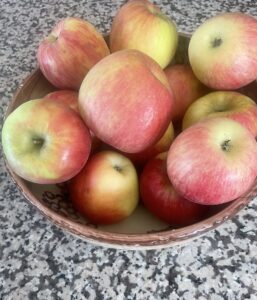 Cathy and I went to the apple orchard yesterday. It’s our custom this time of year. We don’t pick our own anymore, but we always buy a peck of Honeycrisp and a half-dozen pumpkin donuts. We eat a donut in our car, and then we drive home. We fill a bowl with apples and leave it on our kitchen island. We refrigerate the rest. I eat them raw, and Cathy usually bakes at least one pie. What would our autumns be without Honeycrisp apples? Who would we be without our yearly trip to the orchard?
Ken Kesey, the author of One Flew Over the Cuckoo’s Nest, among other books, says, “Ritual is necessary for us to know anything.” The things we do year after year at the same time center us. We know who we are because we’re the couple who have soup for supper on Christmas Eve and then watch Christmas Vacation. We know who we are because each spring we plant radishes and lettuce in our garden. We know who we are because each autumn we go to the orchard and buy Honeycrisp apples and pumpkin donuts.
Who will we be when the time comes when we can’t do these things? We’ll be different people. We may very well be unable to recognize ourselves. Lives, both real and fictitious, can take unexpected turns, when released from ritual.
What happens to a life disturbed by a ritual interrupted? Stories and novels can come from an exploration of this question. Give a character a ritual. Maybe it’s something they enjoy each year (the first swim in their pool, the first tomato from the garden, a walk in the year’s first snow), or maybe it’s something they do out of duty (a yearly visit with family, placing flowers on a parent’s grave, cleaning out a closet). Invent a reason your character can no longer perform their ritual. What do they do instead? What sort of trouble do they create? What action do they take? What sorts of complications arise? Who does the character become?
Maybe you begin with something like this: Each summer, Mrs. Johnson looked forward to the county fair. It was her chance to show off her prize-winning roses. This summer, though, her arthritis had kept her from her garden, and the roses had suffered from her lack of care. She couldn’t bring herself to be anywhere near the fair on the day the blue-ribbon winners were named, so she went to a movie instead. There, she. . . .
You get the idea. Because your character can’t do what they always do, they choose to do something else. That something else kicks the narrative into motion. Soon, you’ll be following a narrative chain of cause and effect that will eventually have its resolution.