What Manual Work Taught Me about Writing
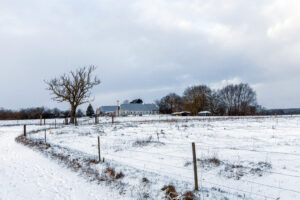
It’s eighteen degrees today in central Ohio, and nearly a foot of snow still covers the ground and the rooftops. Cathy and I get out from time to time to run errands or to enjoy a meal at a restaurant. For the most part, though, we’re content to hibernate. Cathy’s retired, and I’m on sabbatical this semester, so we don’t have a lot of pressing obligations. We can stay inside and let the weather do whatever it wants.
This doesn’t mean we don’t think about those who don’t have the same privilege. We think of those who have to brave the elements because they must be at work. How many leave before sunup and come home after dark? And what of those whose jobs require them to work outside? We feel for all of them.
My father was a farmer; my mother was his helper before and after her hours teaching the third grade. Each morning and evening, she milked our cows. How cold it must have been in the stalls of our barn. How dark before dawn. The only light came from the flame in the kerosene lantern she carried. I imagine her on the milking stool, her cheek pressed against a cow’s flank for what warmth it could offer. I think of her attending to her chore morning after morning. What choice did she have? My father couldn’t help because, as many of you know, he’d lost both of his hands in a farming accident and wore prostheses, and I was too young to be of any assistance at all. And the cows? Well, cows had to be milked, and on our farm, my mother was the one to do it, no matter how cold the winter might be.
I remember my father using an axe to break up the ice in the pond where our hogs got their water. How red his face was when he finally came back to the house. How wet were his boots and the legs of his overalls. But the job was done until the next morning, if we were in the midst of a long cold spell, when he’d have to take the axe to the ice again.
When I was an undergraduate student at Eastern Illinois University, I left school and worked in a factory for a little over a year. This was in the spring of 1976 through the summer of 1977. To cut energy costs in the winter, the factory went to a four-day work week. We worked ten-hour shifts. I worked in a press room, molding plugs and patches for the inner tubes of tires, back in the day when there were such things. It was repetitive work—the press loaded with rubber, closed, opened, unloaded, loaded and closed again. It was exhausting work. It was dirty work. I came home each evening, bathed, ate supper, and fell asleep.
All of this is to say that manual labor—that which I learned on our farm and that which I learned in the factory—taught me what I now put to use in my life as a writer. I’m well aware it’s a life many might consider cushy, and when compared with the life of a farmer or a factory worker, it is. I learned when the work is hard—either the writing or the farming or the production of tire repair materials—to keep going. Farming and factory work taught me to forget about quitting. It’s not an option. There’s a job to be done, and I’m the one to do it. I also learned to take pleasure in the work wherever I could find it. The noise of the press room made it a place where I could sing, and if someone happened to hear me over the sound of the machines and the big fans that ran so be it. Disking a field, moving one direction and then another, back and forth, presented the perfect opportunity for daydreaming. The same is true for the stalled sections of writing time. I can “sing” by concentrating on writing one true sentence. I can make that sentence beautiful by trying it first one way and then another until it has some resonance. I don’t have to think about the piece as a whole, just that one sentence that will then lead to another sentence and another, etc. If I’m completely stuck, I can close my eyes or gaze out my window and let my daydreams take me wherever the thing I’m writing wants to go. I can be productive by not trying too hard to parent the writing. I can let my subconscious do the work of imagining.
The sun is shining here today. If not for the snow, I’d be tempted to believe it’s warm outside. Our writing can be frustrating from time to time, but we need not let our frustration stop us. We can concentrate on something small like the construction of a single sentence, and we can dream big by imagining certain scenarios until we find the one that will work. Like my mother who milked our cows those winter mornings, and my father who chopped the ice at our pond, and the factory workers I spent my time with, we can keep going.
Lovely, Lee, and so important when we are sliding away from our writing goals. The California Writers Club, which I have been a member for fifteen years, has a motto from the poem, Columbus, by Joaquin Miller, dear friend of Jack London. The final stanza brings the long-awaited resolution. Columbus, “pale and worn,” remains steadfast on deck, peering through the impenetrable darkness. Then, a speck of light appears, growing into “Time’s burst of dawn.” This light signifies not just the sighting of land, but also the validation of Columbus’s faith and perseverance. He “gained a world,” and in doing so, gave the world a powerful lesson: “On! sail on!” The merit of this poem is to encourage us, as writers, to sail on even when the going gets tough.
Love this!Thanks for sharing.
This post brought back some memories of my own experiences with manual labor. I used to stack pallets at my dad’s trucking company. I’d spend hours lifting and arranging them in neat stacks about 8 or 9 high. Two days later, you’d have thought a tornado came through the dock, pallets strewn everywhere by truck drivers in a hurry to get on the road with their load. It was frustrating, but I learned that patience and tenacity are essential elements to a good work ethic — and also to successful writing.
Indeed, Clay. I had a similar experience while working as a department store clerk. I’d spend time straightening up stacks of men’s shirts only to have shoppers mess them up. I’d have to redo my stacks. Sound like revision, doesn’t it? Yes, patience and tenacity and the willingness to redo something.