Snow Was General: Writing Beautiful Sentences
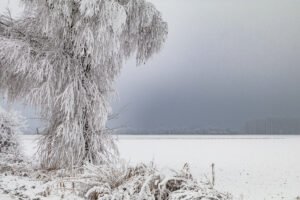
Last night, snow was general all over central Ohio. If you’re a James Joyce fan, you’ll hear the echo of this sentence to the end of Joyce’s story, “The Dead.”
Yes, the newspapers were right: snow was general all over Ireland. It was falling on every part of the dark central plain, on the treeless hills, falling softly upon the Bog of Allen and, farther westward, softly falling into the dark mutinous Shannon waves. It was falling, too, upon every part of the lonely churchyard on the hill where Michael Furey lay buried. It lay thickly on the crooked crosses and headstones, on the spears of the little gate, on the barren thorns. His soul swooned slowly as he heard the snow falling faintly through the universe and faintly falling, like the descent of their last end, upon all the living and the dead.
You don’t need to know a thing about the plot of this story to appreciate the writing of its last paragraph. The lyricism of these last lines portrays the expanding consciousness of our protagonist, Gabriel Conroy. His self-centered and petty nature, through the story his wife Greta tells about her past love, Michael Furey, who died young, has evolved into an understanding of how “one by one they were all becoming shades.” The line between the living and the dead is a thin one indeed. The dead are always with us, and our egoism is a paltry thing given what’s to come. In time, the snow falls over all of us.
Some may consider the sentiments expressed in this final paragraph dark and grim indeed. The beauty of the writing, though, refuses to acknowledge that darkness. The sentences expand and expand. Notice the repetition of the word, “falling,” and how each time it’s used we feel as if the paragraph is reaching further and further toward something so mysterious and yet true. The sentences can’t quite get there until the end.
Notice, too, how the repetition of a single word can cause the paragraph to accelerate. “It was falling on every part of the dark, central plain. . .falling softly upon the Bog of Allen and, farther westward, softly falling into the dark mutinous Shannon waves.” The accent of the first syllable of the word, “falling,” sounds a drumbeat that increases the tempo. Try reading the paragraph aloud, or typing it, as I’ve done, to hear what the word does to the tempo each time it appears.
You should also consider the way Joyce, in the last sentence, varies the repetition: “. . .he heard the snow falling faintly through the universe and faintly falling, like the descent of their last end, upon all the living and the dead”—falling faintly. . .and faintly falling. . . . Switching the position of the two words has an effect on the rhythm of the sentence. The “faintly falling,” combined with the caesura of “like the descent of their last end,” begins the deceleration of the paragraph. The deceleration and the pause allow us to take a breath before the final truth: “upon all the living and the dead.” Slowing down here at the very end forces us to that pause and provides emphasis for the last part of the sentence, which is the last part of the paragraph, which is the last part of the story.
I suppose this is a post for language nerds like me who appreciate the various syntactical strategies one can use to underscore the place to which a story has been moving from its opening. If there’s one thing I can leave you with, it’s this. Slow down at the end. Don’t rush. Let your sentences, not only in their content, but especially in their form, resonate with the beautiful, and sometimes stark truth, your story has come to tell.
Well, I’m glad I tracked that down. Perhaps your best yet. Brought tears to my eyes thank you.
Thanks, Rhonda!
“Slow down at the end.” Sound advice.
Thanks for reading, David.
Lee, there is a beginning paragraph to one of the chapters in your book Such a Life that I always read to my students because I think it’s so beautiful. I have the book at my office, so I can’t quite it right here, but it’s the description of driving down the dusty roads and stopping to pick up a local guy. There’s something about that scene, it’s raw normalcy and yet intensity that I just love.
Linda, the piece you’re talking about is “Drunk Man.” Thanks so much for admiring it.